
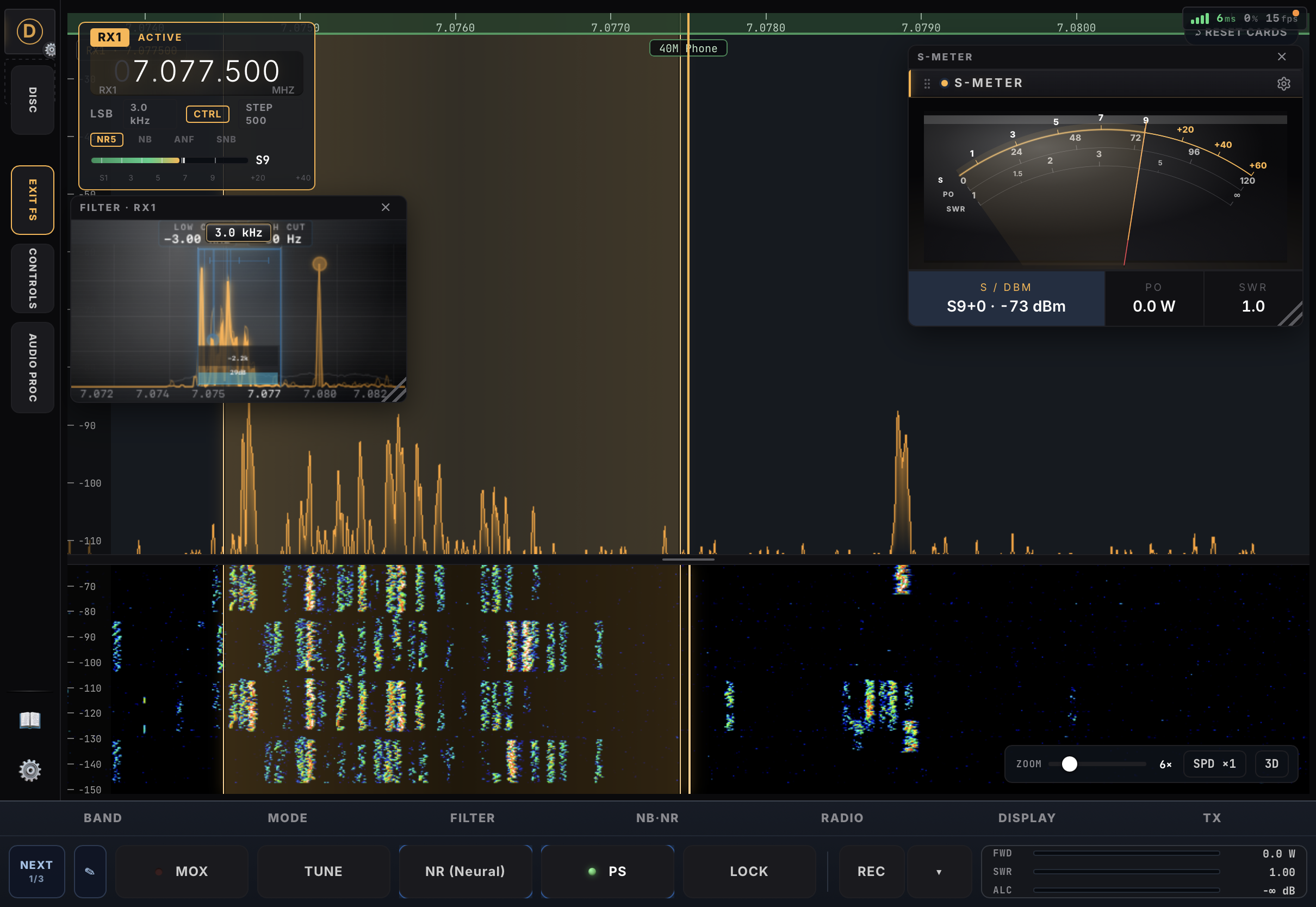
Apache Labs Announces ANAN Core
A New Software Platform for the ANAN Transceiver Range
Irvine, CA — 09/17/2026 — Apache Labs today announced ANAN Core, the new software platform for its ANAN line of Protocol-2 software-defined transceivers, including the Legacy ANANs, ANAN G2, G2 Ultra, G2E and G2-1K.
ANAN Core is an application developed by Apache Labs from open-source foundations and engineered specifically for ANAN hardware. It runs on the radio itself, in any browser on the network, and as a native application on Windows, macOS and Linux. There is no account to create and no subscription.
Why ANAN Core exists
Software for the OpenHPSDR platform has always been open source. That is not incidental — it is the reason an ecosystem of radios, tools and applications was able to grow around the platform at all.
ANAN Core began as OpenHPSDR-Zeus. Its original author, Brian Keating, has reflected publicly his thoughts on the project.
“When Open Source Goes Wrong”, Brian Keating, 9 July 2026
Apache Labs agrees. ANAN Core was built by Apache Labs from the last publicly reachable source and is developed in the open under the GNU General Public License, version 2 or later. Upstream copyright and licence headers are retained in full, and the source for every shipped release is published alongside the binaries at github.com/abhishekprakash22/zeus. Every operator who receives an ANAN radio receives exactly the rights Apache Labs received.
Apache Labs acknowledges the authors of OpenHPSDR-Zeus, on whose software ANAN Core is built: Brian Keating EI6LF, project lead; Douglas J. Cerrato KB2UKA; Ramón Martínez EA5IUE; and Christian Suarez N9WAR.
Apache Labs also thanks those whose work underpins all of it — Dr. Warren Pratt NR0V, whose DSP library has powered SDR applications for more than fifteen years; Richie MW0LGE and the Thetis community around him, whose years of software, infrastructure and ideas advanced amateur radio for everyone; Laurence Barker G8NJJ, architect of the Saturn platform and the Protocol-2 application; and Christoph van Wüllen DL1YCF/ John Melton for piHPSDR — and many more.
Built for the G2 — not adapted to it
Apache Labs designs and manufactures the ANAN radios, and ANAN Core was written against that hardware rather than made to fit it afterwards.
A front panel that behaves the way your hands expect. The G2’s physical buttons, encoders and LEDs are fully supported, and every control is remappable. The multifunction encoder follows the convention Thetis and piHPSDR operators already know: press once and the knob selects a function, press again and it operates it — with the current assignment shown permanently on screen.
A touch interface designed for the 8-inch panel, not a shrunken desktop. Three assignable key decks drawn from a thirteen-key pool, so the controls an operator actually uses are always one press away. Per-receiver panes, each with its own spectrum, waterfall, AGC behaviour and audio. A control popover that reaches mode, audio, AGC threshold, microphone gain and drive without leaving the spectrum. Touch targets sized for fingers, and a layout that remembers how the operator left it — on the radio, so it survives a restart.
Tuned to the hardware it runs on. The spectrum path was profiled and rebuilt on the G2’s own compute module: display work coalesced to a single pass per frame, and tuning data given a priority path of its own so the frequency readout tracks the knob rather than lagging behind a busy display. The result is a radio that feels immediate at the panel — which is where it is judged.
Operate from anywhere
ANAN Core includes complete remote operation built into the radio. There is no account to register, no directory to appear in, and no third party holding the keys: a session username and password, exchanged using a modern zero-knowledge protocol, is the only credential.
Nothing to configure on the network. No port forwarding, no static IP, no VPN, no dynamic-DNS account, no changes to the router at all. Both the radio and the operator’s device dial outward, so a firewall sees ordinary outgoing traffic and the radio is never exposed to the internet. Connections are peer-to-peer wherever the network allows, falling back to a relay only when two networks cannot see each other directly — a case Apache Labs engineered for deliberately, because carrier-grade NAT is the norm across much of the world, and it is precisely the situation that defeats port forwarding.
In practice: set a username and a session password on the radio, open a link, and operate.
Recent optimisation reduced a remote session to roughly 800 kbit/s for a full spectrum display and voice audio, about a quarter of what it previously required. A typical domestic uplink now supports around two dozen simultaneous listeners rather than a handful.
A remote operator gets the same radio, not a cut-down version: full panadapter and waterfall, receive audio, transmit with microphone uplink, FT8 and FT4 decoding, and the front-panel controls mirrored on screen.
The same software everywhere
ANAN Core runs on the radio’s own display, in any browser on the network, and as a native application on Windows, macOS and Linux. It is the same software in every case — not a companion app with a reduced feature set. An operator can start a contest at the radio, continue from a laptop in another room, and finish from a hotel on the other side of the world without learning a different interface.
Measurement and linearity
Live IMD measurement. Third- and fifth-order intermodulation products are measured from the actual transmitted tones and displayed continuously in dBc, so a PureSignal adjustment can be judged by what it does to the signal rather than inferred from it.
PureSignal that converges. ANAN Core includes substantial corrections to the predistortion chain, including a defect that prevented the calibrator from accepting feedback at all. Automatic feedback attenuation escapes the hot-side condition without operator intervention, an over-drive verdict explains a failed calibration in plain language, and an amplifier-response view shows the correction as it forms.
The latest WDSP
The platform has been upgraded to WDSP 2.10, the current release of Dr. Warren Pratt NR0V’s DSP library, bringing NR5 neural noise reduction alongside the existing spectral, RNNoise and spectral-bleach reducers. Apache Labs resolved a latent memory defect during the port that could crash any Linux host on the first transmission.
Modes and features
FreeDV 700D and 700E digital voice transmit and receive, with automatic sub mode detection. Native FT8 and FT4 with an integrated decode and transmit cycle. WSPR. A CW skimmer. Multiple receivers, each independent. Notch, noise blanking, equalization, compression and contest filtering.
Everything updates from inside the radio
Keeping an SDR current has historically meant a laptop, a card reader, a terminal window and a careful reading of the instructions. ANAN Core replaces all of that with three tools built into the software, each reachable from the radio’s own screen or from a browser anywhere on the network.
Over-the-air application updates. ANAN Core checks for a release, downloads and verifies it, installs it in place and restarts — with rollback if anything is wrong. No image to write, no files to copy, nothing to reconfigure afterwards. Settings, layouts and calibration survive the update.
Protocol-2 application updates. The radio’s Protocol-2 server is updated from the same screen. ANAN Core checks first whether an update actually exists and says so plainly when the software is already current, rather than restarting a working radio for nothing.
FPGA gateware updates. An integrated flash writer updates the radio’s FPGA firmware without a programmer, a JTAG cable or a second computer — and it is designed so that it cannot render the board unbootable: the factory recovery image is never overwritten, so a failed or interrupted write leaves the radio able to start and try again.
A 29-chapter operator manual ships with the radio and is reachable from within the software.
Availability
ANAN Core is available now for the ANAN G2, G2 Ultra, G2E and G2-1K, and all legacy models supporting OpenHPSDR Protocol 1 and Protocol 2. Existing radios update over the air.
Windows, macOS and Linux builds, and the full source for every release, are published at:
github.com/abhishekprakash22/zeus/releases
All new G2 Ultras will ship with Core installed, however, on you existing G2 please follow the following steps within a terminal to install the Core SDR for the first time after which the application updates itself every time one is available.
1. sudo apt install -y curl python3
2. sudo apt install -y libwebkit2gtk-4.1-0
3. wget https://raw.githubusercontent.com/abhishekprakash22/zeus/freedv-in-core/installers/factory-install.sh
4. chmod +x factory-install.sh && ./factory-install.sh